
KHH Enviros Logo

KHH Enviros Logo
Showing posts with label environmental. Show all posts

Tuesday, December 15, 2009

Comparing Places - To move or not to move...


In the grand scheme of things, most people in this world don't move around very much, and certainly not over large distances in short periods of time as I have been doing in the past 2+ weeks. People stay in their homes, go to work, see their friends and arrive back in the same spot before they go to bed, then they wake up and do it all over again, and it's for one simple reason: they can't move, they're stuck in the life they have. 

It's an odd thing to consider sometimes, though most of us are stuck in one way or another by the circumstances of our lives. We know this because we're not living out our absolute, perfect, dream-like lifestyle. We have responsibilities, commitments, and social pressures pulling us back to "where we belong." These sorts of things are common the world over and they stop us from doing what we really want all the time.

At this moment I'm in Toronto, on my 9th city and 3rd continent in just 3 weeks, and I'm noticing some stark differences and glaring similarities between places and people.

The most interesting to me at the moment - perhaps also because this is an enviro blog - is the way in which people move around; be it from home to work and back again or over longer distances for other reasons.
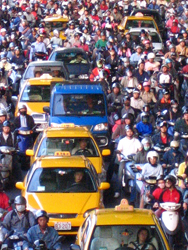

I started in Taiwan where people are in love with their scooters, cars are a status symbol and the brand new MRT (Mass Rapid Transit) is desperate to be recognized as a legitimate form of transportation.


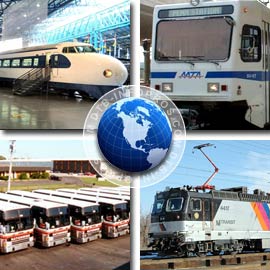
From Taiwan I flew (yes, I know, I hate flying, too) to Europe and stayed in Germany, Holland, Denmark and Britain where mass transit is relied upon for nearly every journey where possible and convenient, though cars still play a role. I found it telling that in Denmark bikes are still used a great deal even in winter, AND that the girl whose birthday we went out for in London made an "unusual request" that we take a taxi to the restaurant instead of the underground. Clearly, cars in Europe aren't quite what they are elsewhere.


And lastly, I've come home to Canada, where bikes are for pleasure, the mass transit is horribly underfunded and cars carry their single passenger over great distances every morning and evening for the commute. The alternatives to taking a car in Canada are groaningly moving forward at a snail's pace. The argument remains: "I need my car because everything is so far away." True, things are far, but do you really need a four-seater to go get groceries or commute 20 minutes to work everyday? Probably not, unless you're bringing 3 imaginary friends with you.

Now, I don't like to country bash, and pointing out the faults in my own country is easy when you live abroad and are happy about it, but I find it a little frustrating coming back to Canada. After having traveled so seamlessly through Europe on smooth-gliding high speed trains and well managed tram systems which run throughout the country - even in small cities like where I used to live in Germany - I'm ready to start criticizing a little bit.

There comes a time when we have to wake up as a country and realize that the world is passing us by, and all the while we're convinced of our own superiority. Asia is hard at work building their transit infrastructure and using Europe technology to do so. They're asking the experts and paying them well to make their societies more livable. We are not.
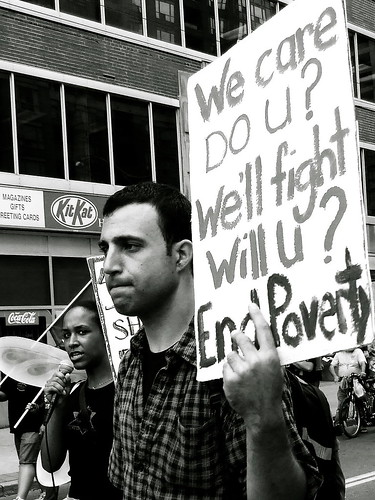


Good transit is also a poverty issue, and you can ask any economist; poverty is bad for business. If a person from Mississauga can get quickly and easily across the city without a car, then more job opportunities open up. In this way cities can reduce the poor's dependence on welfare and gain more tax-paying citizens.

At the moment we have the economic advantage, but that is largely dependent upon variables like infrastructure and - perhaps most importantly - attracting talent. What does it say about Canada when the most talented of my friends (and the least as well) aren't staying in Canada because they want to, but rather because they feel stuck in those responsibilities, which keep the rest of the world from moving around?

It won't stay like this forever. Those who stick with what they've always done will only get what they've always had. In a world that's progressing very quickly, we just can't afford to have such a crappy mass transit infrastructure. It's a detriment to our people and it's a large part of why I don't want to move back to Canada.


Environmentalism is no longer a movement of hippies and frustrated youth, it's a global movement that is touching every economic field with a large, firm index finger.

If we continue to ignore that, in transportation or any other sector, we will be left behind.

Thursday, November 26, 2009

KHH Enviros Interviewed by Taipei Times

Well,
As the old saying goes: if you scream loud enough, eventually someone will ask you "what's wrong?"
It appears that person was Jenny Hsu from the Taipei who interviewed Tim, our Managing director...ahem, me.

The article is now online at Taipeitimes.com but here's a copy just in case you missed it.
Or click here to go to the Jenny Hsu's Interview with the KHH Enviros
------------------------------------------------------------------
COMMUNITY COMPASS: Canadian on a mission to turn Kaohsiung green
GREENHEAD: Instead of complaining about the smog and the litter, Tim Higgs organized KHH Environs to teach people how to 'greenify' the city
By Jenny W. Hsu
STAFF REPORTER
Tuesday, Jul 21, 2009, Page 4

VIEW THIS PAGE

For environmental activist Tim Higgs, being a contagious agent who spreads the “green bug” in Kaohsiung is exactly what he has in mind.

The 26-year-old Higgs, who hails from Ontario, Canada, got involved in the global environment protection movement because of his experience working with non-governmental organizations (NGOs), as well as in the private sector, on energy and water efficiency in Canada.

“I loved my job because it was something that made you feel good about yourself when you went to work in the morning,” he said, referring to his job in Canada.

“Moreover, I was constantly learning new things each day on the job,” he said, adding that he missed that feeling when he moved to Germany.

But even there, he was inspired by the German government's commitment to green energy and the people's love for the Earth, he said.

When he moved to Kaohsiung last year, he said he was greeted not only by the area's famous southern hospitality, but also by the heavy smog that enveloped the city.

“You don't need a big reason to want to do something for the environment here in Kaohsiung. Just look around you or breathe in the air in the city,” said the English teacher, recalling the time when he lived in an apartment downtown, where he could not even open the windows without smelling exhaust fumes from heavy traffic.

“Within in a day, there would be a layer of dirty black grime so thick that you couldn't dust off. The pollution was in your face all the time and you just couldn't escape from it,” he said.

Instead of moaning and groaning about the constant battle with the smog-filled air and the litter, Higgs decided to roll up his sleeves and go to work by organizing the KHH Enviros, a community-based group to educate the public about ways to “greenify” the city.

Higgs used a technique called “community-based social marketing,” which involves engaging the community from a market perspective.

“What you do is first find out everything you can about the problem you are seeking to solve. Once you have done that, you find out about the barriers that are stopping people from doing a behavior that you want them to do,” he said.

Take littering for example, he said, a big barrier to people disposing their garbage properly is the low number of public garbage cans.

Taiwan's trash pick-up system presents another problem to making people more environmentally conscious, he said.

The next step to shaping public behavior is to get them to change the way they view themselves — from ordinary citizens that are detached from the movement to “green people” who are committed to cleaning up the city in a sustainable manner.

Higgs and his group of volunteers do this by passing out stickers that say “Greenhead.”

“This might sound simple but it is an effective method. Having the sticker on your scooter, you are telling the world that you are an 'environmental person,' which means whenever someone asks you about it, you either have to strengthen the identity inside yourself or discard it. We find that most people do the former,” he said.

In addition to organizing projects such as beach clean-ups, the group offers various “green tips” on its monthly newsletters to raise public awareness that protecting the environment is often easier than many would think.

Higgs said one of the goals of KHH Enviros is to be able to partner up with the city government on different city beautification projects.

Like many NGOs in the country, KHH Enviros faces the twin problems of cash and staffing shortage. For more information on the group and volunteer opportunites, check out www.khhenviros.webs.com/home.html